
Illustrative / composite journey: This story is a fictionalized composite based on common themes reported in clinics, trials, and public education materials. It is not a real patient's account, not a testimonial, and not a prediction of your results. Individual responses to medication vary widely.
Not medically reviewed.
Getting started
Where to inject Zepbound, and how to do it step by step
Where to inject Zepbound (abdomen, thigh, back of upper arm), how the pen, vial and KwikPen work, and how to rotate sites, per the FDA-approved instructions.

Talk to your clinician: Dosing, side-effect management, and whether a medication is appropriate for you are personalized medical decisions. Use this article to draft questions — not to change your prescription on your own.
Last reviewed: November 11, 2026. Sources checked against the Zepbound prescribing information and Medication Guide (revised 11/2026) and the Zepbound Instructions for Use (single-dose pen and single-dose vial revised April 2026; multi-dose vial and KwikPen revised January 2026).
Your first Zepbound injection can feel like a big moment. The good news: the steps are short, the FDA-approved instructions are clear, and your care team is supposed to train you before you do it alone. This guide walks through where the label says you can inject, how each Zepbound presentation works, and how to rotate sites from week to week. It's a companion to your training, not a replacement for it.
The short answer: where to inject Zepbound
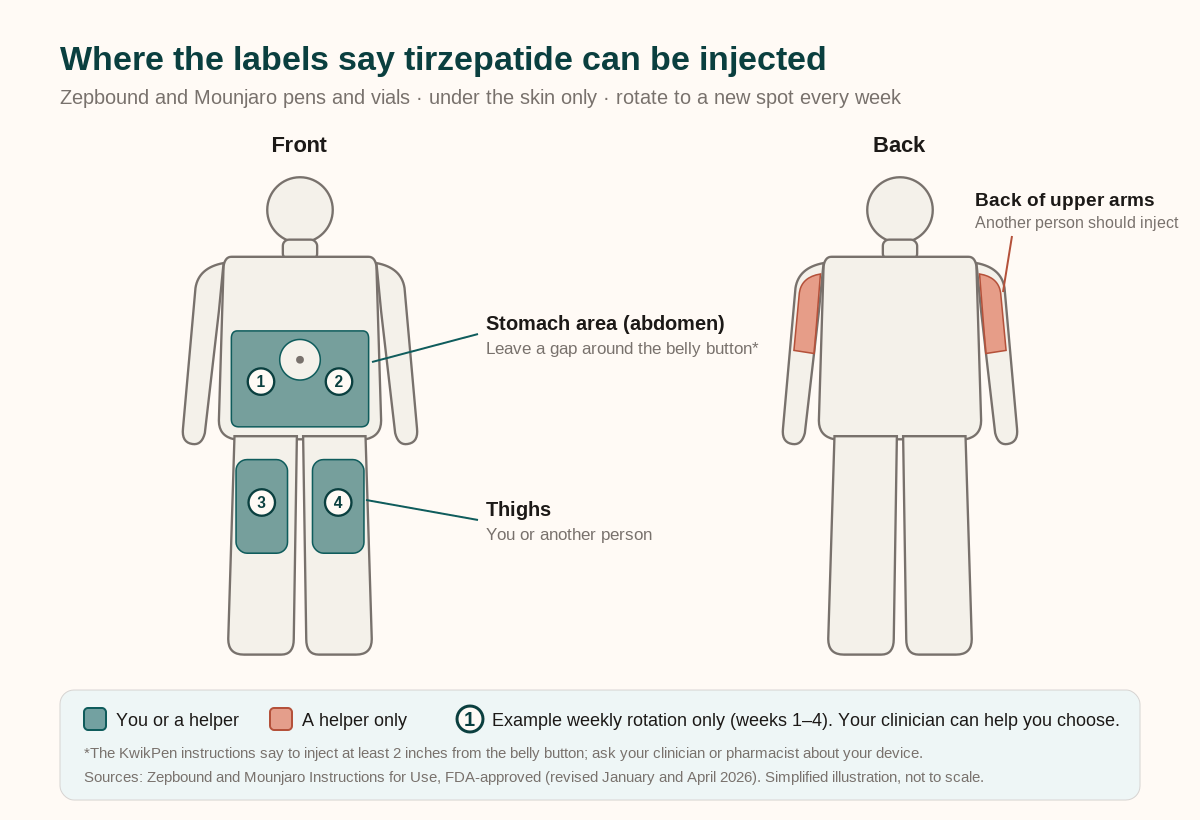
The Zepbound label lists three areas, all under the skin (subcutaneous):
- Stomach area (abdomen) — you or another person can inject here.
- Thigh — you or another person can inject here.
- Back of the upper arm — another person should give the injection here.
The prescribing information also says to rotate injection sites with each dose. The Medication Guide explains that you can keep using the same body area, as long as you pick a different spot within it each week. It also says not to inject Zepbound into a muscle or a vein (Zepbound USPI §2.4; Zepbound Medication Guide).
A note about the belly button
The instructions for the multi-dose Zepbound KwikPen specifically say to inject in the abdomen at least 2 inches from the belly button (Zepbound KwikPen Instructions for Use). The single-dose pen instructions don't give a distance, so it's worth asking your clinician or pharmacist where they'd like you to stay clear of.
Why the back of the arm needs a helper
Every Zepbound Instructions for Use reserves the back of the upper arm for another person to inject (Zepbound IFUs). If you inject on your own, the abdomen and thighs are the areas the label says you can use yourself.
Which Zepbound do you have?
Zepbound now comes in four presentations, and each one has its own Instructions for Use (IFU). The label tells clinicians to make sure you're trained on the specific presentation you receive, and to retrain you if it changes (Zepbound USPI §2.4).
| Presentation | What it is | How a dose is given |
|---|---|---|
| Single-dose pen | Prefilled autoinjector, one dose per pen | Place, unlock, press and hold the button |
| Single-dose vial | One 0.5 mL dose per vial | Draw up with a new syringe and needle |
| Multi-dose vial | Four weekly 0.6 mL doses per vial | Draw up with a new syringe and needle each week |
| KwikPen | Single-patient-use pen with four fixed weekly doses | New pen needle, prime, dial, inject |
Source: Zepbound USPI §3 and §16.1.
Whichever you have, the label says to check the liquid first. It should look clear and colorless to slightly yellow. Don't use it if you see particles or discoloration (Zepbound USPI §2.4).
How to inject Zepbound with the single-dose pen
These steps summarize the FDA-approved single-dose pen IFU (revised April 2026). Keep the leaflet that came with your pen handy, since it has pictures of each part (Zepbound single-dose pen IFU).
Before you start
- Take the pen out of the refrigerator. Leave the gray base cap on until you're ready to inject.
- Check the label: right medicine, right dose, not expired. Make sure the pen isn't damaged.
- Look at the medicine. It shouldn't be frozen or cloudy, and it shouldn't have particles. It should be colorless to slightly yellow.
- Wash your hands.
The IFU's FAQ says you don't need to warm the pen to room temperature first, and that air bubbles are normal.
Step 1: Choose your injection site
Pick the abdomen or thigh (or the back of the upper arm, if someone else is injecting). Choose a different spot from last week's.
Step 2: Pull off the gray base cap
Make sure the pen is locked. Pull the cap straight off and throw it in your household trash. Don't put it back on, as that could damage the needle. Don't touch the needle. A drop of liquid on the needle tip is normal.
Step 3: Place the clear base on your skin, then unlock
Set the clear base flat against your skin at the site. Then unlock by turning the lock ring.
Step 4: Press and hold for up to 10 seconds
Press and hold the purple injection button for up to 10 seconds and listen:
- First click = injection started.
- Second click = injection completed.
You'll know it's done when the gray plunger is visible. Some people hear a soft click just before the second loud click, which the IFU says is normal. Don't lift the pen until you hear that second loud click.
After the injection
- A drop of liquid or blood on your skin is normal. Press a cotton ball or gauze on it, and don't rub.
- Put the used pen in an FDA-cleared sharps container right away, not in household trash. The IFU explains what to use if you don't have one, and points to FDA's safe sharps disposal page for local rules.
- If you can't see the gray plunger and aren't sure the pen worked, the IFU says to contact Lilly at 1-800-545-5979 and store the pen safely until then.
The pen has glass parts. If you drop it on a hard surface, the IFU says not to use it and to use a new pen instead.
How the vials and KwikPen differ
If your pharmacy gave you a vial or a KwikPen, the injection areas are the same, but the preparation isn't. Here are the main differences, summarized from the IFUs (Zepbound IFUs). Ask for hands-on training for your device.
Single-dose and multi-dose vials
- Use a new syringe and needle for every injection. The label gives a 1 mL syringe that can measure 0.5 mL or 0.6 mL as an example (Zepbound USPI §2.4). Never share or reuse syringes or needles.
- The single-dose vial IFU walks you through drawing up 0.5 mL. The multi-dose vial IFU uses 0.6 mL per weekly dose.
- The IFU says your healthcare provider should tell you whether to pinch the skin before injecting.
- After pushing the plunger, the needle should stay in for at least 5 seconds.
- Don't recap the needle, as that can cause a needle-stick injury.
- A single-dose vial is thrown away after use, even if some medicine is left.
KwikPen (four doses per pen)
- Attach a new KwikPen-compatible pen needle each week. Needles aren't included.
- Prime before each weekly injection until a drop appears at the needle tip.
- Turn the dose knob all the way until it stops and the icon shows in the dose window. Don't count clicks.
- Push the knob in and slowly count to 5 before removing the needle.
- Throw the pen away after 4 doses or 30 days after first use, whichever comes first, even if medicine is left. Don't try to inject leftover medicine.
- Never share a KwikPen, even with a new needle, because of the risk of passing on blood-borne infections (Zepbound USPI §5.11).
- The label says the KwikPen isn't recommended for self-injection by people who are visually impaired (Zepbound USPI §2.4). The KwikPen IFU adds that people who are blind or have vision problems shouldn't use the pen without help from a person trained to use it (Zepbound KwikPen IFU).
How to rotate injection sites
The label's rule is simple: a different site every week. The vial IFUs explain why. Rotating within the area you choose lowers the risk of lipodystrophy (pits or thickened skin) and localized cutaneous amyloidosis (lumps under the skin) at injection sites (Zepbound vial IFUs).
Those IFUs also say:
- Don't inject where the skin has pits, is thickened, or has lumps.
- Don't inject where the skin is tender, bruised, scaly or hard, or into scars or damaged skin.
- Don't use the same site you use for other injected medicines.
A simple rotation idea (not a rule): One approach is to cycle through four spots, such as the left and right abdomen and then the left and right thigh, as the diagram above shows. Jotting the spot in a phone calendar on injection day can make it easy to remember where you went last time. Your clinician can suggest what fits your body and routine.
What's normal afterward, and what isn't
Injection-site reactions such as redness, itching, bruising or pain were reported in 6% to 8% of people taking Zepbound in the main weight-reduction trials, compared with 2% on placebo (Zepbound USPI, Table 1). If a reaction bothers you or won't go away, show it to your clinician or pharmacist.
The label also describes serious allergic reactions. The Medication Guide says to stop using Zepbound and get medical help right away for swelling of the face, lips, tongue or throat, trouble breathing or swallowing, a severe rash or itching, fainting or dizziness, or a very rapid heartbeat (Zepbound Medication Guide).
Seek urgent care or emergency help for symptoms such as severe or persistent abdominal pain (with or without vomiting), signs of a severe allergic reaction (swelling of face/lips/tongue, trouble breathing), symptoms of pancreatitis or gallbladder problems as described on your medication guide, chest pain, fainting, or thoughts of self-harm. This list is not complete — follow your clinician's and the product Medication Guide's instructions.
Where your pens come from
If you're still deciding where to fill your prescription, our sister site has a guide to filling a GLP-1 prescription safely. The FDA warns that unapproved GLP-1 products sold online may not be what they claim to be (FDA).
Illustrative / composite: “Renee's” first pen
Illustrative / composite journey: This story is a fictionalized composite based on common themes reported in clinics, trials, and public education materials. It is not a real patient's account, not a testimonial, and not a prediction of your results. Individual responses to medication vary widely.
Renee (composite), 61, practices with the nurse first. At home, she sets the pen, a cotton ball and a small sharps container on a clean towel, and reads the leaflet once more. She chooses the left side of her abdomen, clear of her belly button, and keeps her eyes on the pen through both clicks. The plunger is gray in the window, and there's one tiny drop of blood, which she presses without rubbing. She writes "abdomen, left" in her phone. Next week, her daughter offers to do the back of her arm. Renee decides she'd rather stick to the abdomen and thigh for now, which the label allows too.
FAQ
Where is the best place to inject Zepbound?
The label doesn't rank one site above another. It lists the abdomen, thigh, and back of the upper arm (given by someone else) and asks you to rotate weekly. The pen IFU says your healthcare provider can help you choose the site that's best for you (Zepbound pen IFU).
What if I miss a dose?
The label says to take it as soon as possible within 4 days (96 hours). If more than 4 days have passed, skip it and take the next dose on your regular day. Don't take two doses within 3 days of each other (Zepbound Medication Guide). Check with your pharmacist if you're unsure.
Do I need to let the pen warm up?
The single-dose pen IFU says it isn't necessary to warm the pen to room temperature (Zepbound pen IFU). For storage limits, see our guide to storing Zepbound.
The bottom line
Zepbound goes under the skin of the abdomen or thigh, or the back of the upper arm if someone else injects. Use a new spot every week, and follow the IFU for your specific pen or vial. Ask for hands-on training, keep a sharps container nearby, and call your clinician about anything that doesn't look or feel right. Using Mounjaro instead? See how to inject Mounjaro. For more on getting started, see what GLP-1 medications are and your first month, week by week.
Sources
- Eli Lilly and Company. Zepbound (tirzepatide) injection, U.S. prescribing information. Revised 11/2026
- Eli Lilly and Company. Zepbound prescribing information, Medication Guide (revised 11/2026) and Instructions for Use for the single-dose pen (revised April 2026), single-dose vial (revised April 2026), multi-dose vial (revised January 2026) and KwikPen (revised January 2026)
- DailyMed. Zepbound (tirzepatide) injection label (SPL version published September 2, 2026)
- U.S. Food and Drug Administration. Safely using sharps (needles and syringes) at home, at work and on travel (accessed November 11, 2026)
- U.S. Food and Drug Administration. FDA's concerns with unapproved GLP-1 drugs used for weight loss (content current as of 10/01/2026)
More in Getting started
Getting started
Is Zepbound the same as Mounjaro or Ozempic?
Zepbound and Mounjaro share one medicine, tirzepatide. Ozempic is semaglutide. Here's how their approvals, uses, doses and devices compare, per FDA labels.
Getting started
What the SURMOUNT trials showed at each Zepbound dose
What the SURMOUNT trials reported at each Zepbound dose (5, 10 and 15 mg): weight change, side effects and dropouts, from the FDA label. Not dosing advice.
Getting started
Does Zepbound need to be refrigerated? A storage guide
Does Zepbound need to be refrigerated? What the FDA label says about fridge temperatures, the 21-day room-temperature allowance, travel, light and freezing.
Getting started
How to inject Mounjaro: pen, vial and KwikPen steps
How to inject Mounjaro, per the FDA-approved instructions: where it goes, pen steps, vials and KwikPen, site rotation, and using it with insulin.
Getting started
How does Zepbound work?
How Zepbound (tirzepatide) works: GIP and GLP-1 receptors, appetite, stomach emptying, insulin, and why the FDA label supports once-weekly dosing.
Getting started
Where to inject Ozempic, and how to use the pen
Where to inject Ozempic (abdomen, thigh, or upper arm), how to rotate sites, and step-by-step pen and syringe use, from the FDA-approved instructions.
Getting startedIllustrative
Your first month on a GLP-1: a week-by-week guide
Week-by-week guide to your first month on semaglutide or tirzepatide: starter doses, side effects, food habits, and red flags, with FDA-label citations.
Getting started
What are GLP-1 medications? A plain-English guide
A plain-English guide to GLP-1 and GIP/GLP-1 medicines: how they work, how brands differ, what trials and labels say, and what daily life often involves.