
Not medically reviewed.
Getting started
How to inject Mounjaro: pen, vial and KwikPen steps
How to inject Mounjaro, per the FDA-approved instructions: where it goes, pen steps, vials and KwikPen, site rotation, and using it with insulin.

Talk to your clinician: Dosing, side-effect management, and whether a medication is appropriate for you are personalized medical decisions. Use this article to draft questions — not to change your prescription on your own.
Last reviewed: November 11, 2026. Sources checked against the Mounjaro prescribing information and Medication Guide (revised 11/2026) and the Mounjaro Instructions for Use (single-dose pen and single-dose vial revised April 2026; multi-dose vial and KwikPen revised January 2026).
Mounjaro (tirzepatide) is a once-weekly injection for type 2 diabetes. If you've just been prescribed it, the injection itself is usually the part people worry about most. This guide explains what the FDA-approved instructions say: where Mounjaro goes, how each device works, how to rotate spots, and what to know if you also use insulin. Your clinician or pharmacist should still show you in person before your first dose.
What Mounjaro is approved for
Mounjaro is a GIP and GLP-1 receptor agonist. Its label lists two uses:
- along with diet and exercise, to improve blood sugar control in adults and in children 10 years and older with type 2 diabetes
- to reduce the risk of major cardiovascular events (cardiovascular death, non-fatal heart attack or non-fatal stroke) in adults with type 2 diabetes who are at high risk for these events
Source: Mounjaro USPI §1, revised 11/2026.
Zepbound contains the same medicine, but its label covers weight reduction and obstructive sleep apnea instead. Our Zepbound injection guide covers that label.
Where to inject Mounjaro
The label says to inject Mounjaro under the skin (subcutaneously) in one of these areas (Mounjaro USPI §2.2; Mounjaro Medication Guide):
- Stomach area (abdomen), by you or another person
- Thigh, by you or another person
- Back of the upper arm, by another person
The Medication Guide adds: don't inject into a muscle or a vein, and change (rotate) your site with each weekly injection.
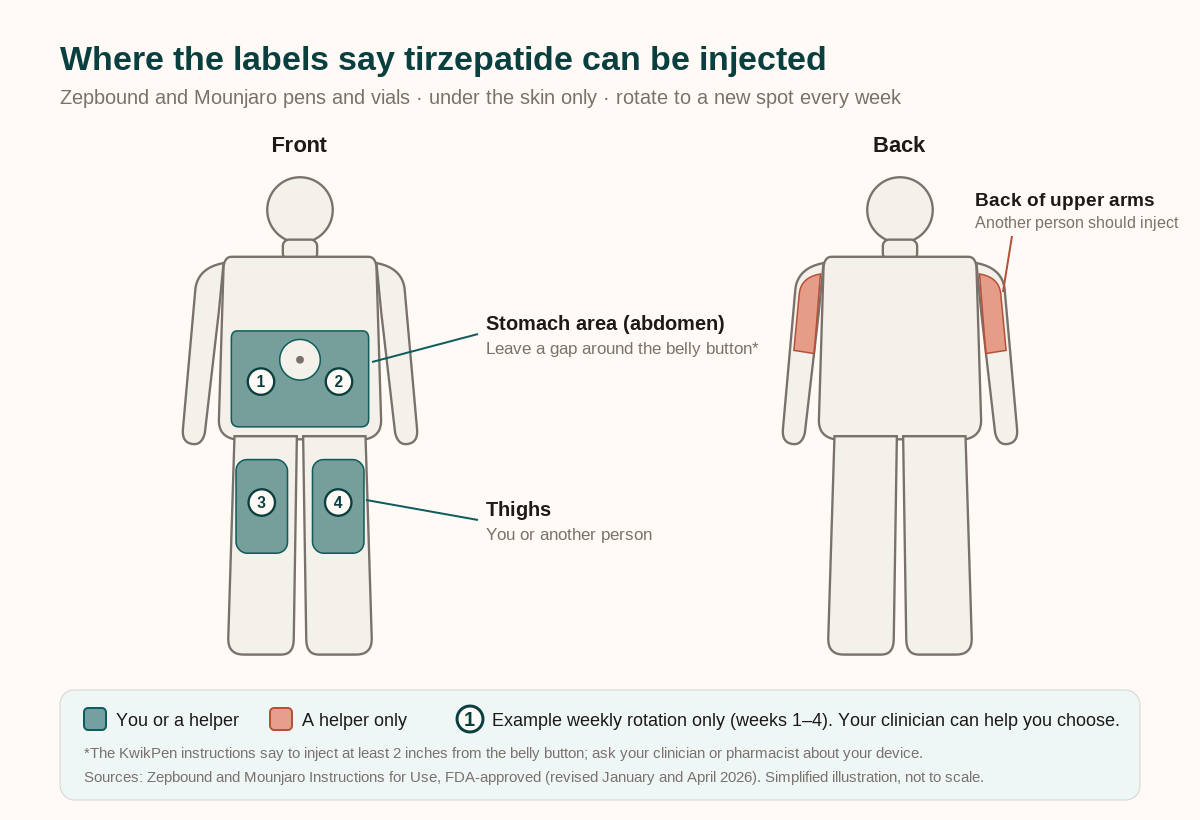
If you use the Mounjaro KwikPen, its IFU says to inject the abdomen at least 2 inches from the belly button (Mounjaro KwikPen IFU).
Mounjaro devices at a glance
The label lists four presentations. The multi-dose vial and KwikPen each hold four weekly doses (Mounjaro USPI §3).
| Device | Doses inside | What you'll need |
|---|---|---|
| Single-dose pen | 1 | The pen (needle built in) and a sharps container |
| Single-dose vial | 1 (0.5 mL) | A new syringe and needle, alcohol swab, gauze |
| Multi-dose vial | 4 (0.6 mL each) | A new syringe and needle every week, alcohol swab, gauze |
| KwikPen | 4 fixed doses | A new KwikPen-compatible pen needle every week, alcohol swab |
Before any injection, the label says to look at the medicine. It should be clear and colorless to slightly yellow, with no particles or discoloration (Mounjaro USPI §2.2). The IFUs add that it shouldn't be frozen or cloudy.
How to inject Mounjaro with the single-dose pen
Here are the four steps from the single-dose pen IFU, revised April 2026 (Mounjaro pen IFU).
Get ready: Take the pen out of the refrigerator and leave the gray base cap on. Check that the label shows the right medicine and dose and that it hasn't expired. Look the pen over for damage, check the liquid, and wash your hands.
- Choose your site. Use the abdomen or thigh, or the back of the upper arm if someone else is injecting. Use a different spot from last week.
- Pull off the gray base cap. Make sure the pen is locked first. Throw the cap away and don't put it back on. Don't touch the needle.
- Place the clear base flat on your skin, then unlock by turning the lock ring.
- Press and hold the purple button for up to 10 seconds. You'll hear a first click when the injection starts and a second click when it's complete. The gray plunger becomes visible when it's done.
Afterward: Put the pen straight into an FDA-cleared sharps container. If there's a drop of blood, press with a cotton ball or gauze, and don't rub.
Small things the IFU says are normal
- Air bubbles in the pen.
- A drop of liquid on the needle tip after the cap comes off.
- A soft click just before the second loud click. Keep the pen in place until the second loud click.
- No warm-up needed. It isn't necessary to bring the pen to room temperature.
If you're not sure the pen worked and the gray plunger isn't visible, the IFU says to call Lilly at 1-800-545-5979. If you drop the pen on a hard surface, don't use it, because it contains glass.
Using a Mounjaro vial
The vial IFUs follow the same basic pattern, with a few extra steps (Mounjaro vial IFUs):
- Remove the plastic cap (new vial) and wipe the rubber stopper with an alcohol swab.
- Attach the needle to the syringe if it isn't pre-attached, then take off the needle shield.
- Draw air into the syringe to the dose line (0.5 mL for the single-dose vial, 0.6 mL for the multi-dose vial) and push it into the vial.
- Turn the vial upside down, draw the liquid just past the line, tap out bubbles, then push back to the exact line.
- Inject under the skin. Your healthcare provider should tell you whether to pinch the skin.
- Leave the needle in for at least 5 seconds, then pull it out. Don't recap it. Put it in a sharps container.
The label says to always use a new syringe and needle for each injection (Mounjaro USPI §2.2). Single-dose vials are thrown away after one use, even if medicine is left.
Using the Mounjaro KwikPen
The KwikPen holds four fixed weekly doses (Mounjaro KwikPen IFU). Key points from its IFU:
- Attach a new pen needle each week.
- Prime before every injection until a drop of medicine appears.
- Turn the dose knob all the way until it stops and the icon shows in the window.
- Push the knob in and count slowly to 5 before taking the needle out.
- Throw the pen away after 4 doses or 30 days after first use, even if medicine is left.
- Never share a KwikPen, even with a new needle (Mounjaro USPI §5.11).
The label says the KwikPen isn't recommended for self-injection by children or by people who are visually impaired. The Medication Guide says an adult caregiver should give a child's KwikPen injections (Mounjaro USPI §2.2; Mounjaro Medication Guide).
Rotating sites, and what to avoid
Rotation is part of the label, not just a tip. The vial IFUs say that rotating within your chosen area lowers the risk of lipodystrophy (pits or thickened skin) and localized cutaneous amyloidosis (lumps under the skin). They also say not to inject:
- where the skin has pits, is thickened, or has lumps
- where the skin is tender, bruised, scaly or hard
- into scars or damaged skin
- in the same site you use for other medicines
Source: Mounjaro vial IFUs.
A simple way to keep track is to note the area and side each week ("thigh, right") in your phone or a paper log. Ask your clinician or diabetes educator if you'd like help planning a rotation.
If you also use insulin
If you use insulin as well, the Mounjaro label says (Mounjaro USPI §2.2; Mounjaro Medication Guide):
- Never mix insulin and Mounjaro in the same injection. Give them as separate injections.
- You can inject both in the same body area, such as your abdomen, but not right next to each other.
The label also warns that using Mounjaro with insulin or a sulfonylurea can raise the risk of low blood sugar, and that those doses may need adjusting (Mounjaro USPI §5.3). Don't change any doses on your own. Ask your clinician what to watch for.
Injection-site reactions and when to call
In the label's pool of placebo-controlled trials in adults, injection-site reactions were reported in 3.2% of people on Mounjaro and 0.4% on placebo (Mounjaro USPI §6.1). Mention any reaction that bothers you or won't go away to your clinician or pharmacist.
The Medication Guide lists signs of a serious allergic reaction, such as swelling of the face, lips, tongue or throat, or trouble breathing or swallowing. If you have any of them, stop using Mounjaro and get medical help right away (Mounjaro Medication Guide).
Seek urgent care or emergency help for symptoms such as severe or persistent abdominal pain (with or without vomiting), signs of a severe allergic reaction (swelling of face/lips/tongue, trouble breathing), symptoms of pancreatitis or gallbladder problems as described on your medication guide, chest pain, fainting, or thoughts of self-harm. This list is not complete — follow your clinician's and the product Medication Guide's instructions.
FAQ
Does Mounjaro hurt to inject?
The label doesn't measure injection pain directly, though it does report injection-site reactions (above). If injections are stressful, ask your clinician or pharmacist to watch you do one. A trained second set of eyes can help.
What time of day should I take Mounjaro?
The label says once weekly, any time of day, with or without meals. You can change your injection day as long as doses are at least 3 days (72 hours) apart (Mounjaro USPI §2.1–2.2).
What if I forget a dose?
Per the label, take it as soon as possible within 4 days (96 hours). If more than 4 days have passed, skip it and take the next dose on your usual day (Mounjaro USPI §2.1). If you're unsure, check with your pharmacist.
Can I inject Mounjaro straight from the fridge?
The single-dose pen IFU says it isn't necessary to warm the pen to room temperature. Mounjaro's storage rules match Zepbound's. Our Zepbound storage guide explains the room-temperature limits for each device.
Is Mounjaro the same as Zepbound?
They share the same active ingredient, tirzepatide, but have different FDA-approved uses. See Is Zepbound the same as Mounjaro or Ozempic?, or our sister site's side-by-side Mounjaro vs. Zepbound comparison.
The bottom line
Mounjaro goes under the skin of the abdomen or thigh, or the back of the upper arm if someone else injects. Use a different spot every week, and follow the IFU for your exact device. If you also use insulin, keep the injections separate and not side by side, and ask your clinician about low blood sugar. Get hands-on training, and ask questions whenever something seems off.
Sources
- Eli Lilly and Company. Mounjaro (tirzepatide) injection, prescribing information, Medication Guide (both revised 11/2026), and Instructions for Use for the single-dose pen (revised April 2026), single-dose vial (revised April 2026), multi-dose vial (revised January 2026) and KwikPen (revised January 2026)
- Eli Lilly and Company. Mounjaro U.S. prescribing information (PDF). Revised 11/2026
- DailyMed. Mounjaro (tirzepatide) injection label (SPL published September 2, 2026)
- U.S. Food and Drug Administration. Safely using sharps (needles and syringes) at home, at work and on travel (accessed November 11, 2026)
More in Getting started
Getting started
Is Zepbound the same as Mounjaro or Ozempic?
Zepbound and Mounjaro share one medicine, tirzepatide. Ozempic is semaglutide. Here's how their approvals, uses, doses and devices compare, per FDA labels.
Getting started
What the SURMOUNT trials showed at each Zepbound dose
What the SURMOUNT trials reported at each Zepbound dose (5, 10 and 15 mg): weight change, side effects and dropouts, from the FDA label. Not dosing advice.
Getting started
Does Zepbound need to be refrigerated? A storage guide
Does Zepbound need to be refrigerated? What the FDA label says about fridge temperatures, the 21-day room-temperature allowance, travel, light and freezing.
Getting startedIllustrative
Where to inject Zepbound, and how to do it step by step
Where to inject Zepbound (abdomen, thigh, back of upper arm), how the pen, vial and KwikPen work, and how to rotate sites, per the FDA-approved instructions.
Getting started
How does Zepbound work?
How Zepbound (tirzepatide) works: GIP and GLP-1 receptors, appetite, stomach emptying, insulin, and why the FDA label supports once-weekly dosing.
Getting started
Where to inject Ozempic, and how to use the pen
Where to inject Ozempic (abdomen, thigh, or upper arm), how to rotate sites, and step-by-step pen and syringe use, from the FDA-approved instructions.
Getting startedIllustrative
Your first month on a GLP-1: a week-by-week guide
Week-by-week guide to your first month on semaglutide or tirzepatide: starter doses, side effects, food habits, and red flags, with FDA-label citations.
Getting started
What are GLP-1 medications? A plain-English guide
A plain-English guide to GLP-1 and GIP/GLP-1 medicines: how they work, how brands differ, what trials and labels say, and what daily life often involves.